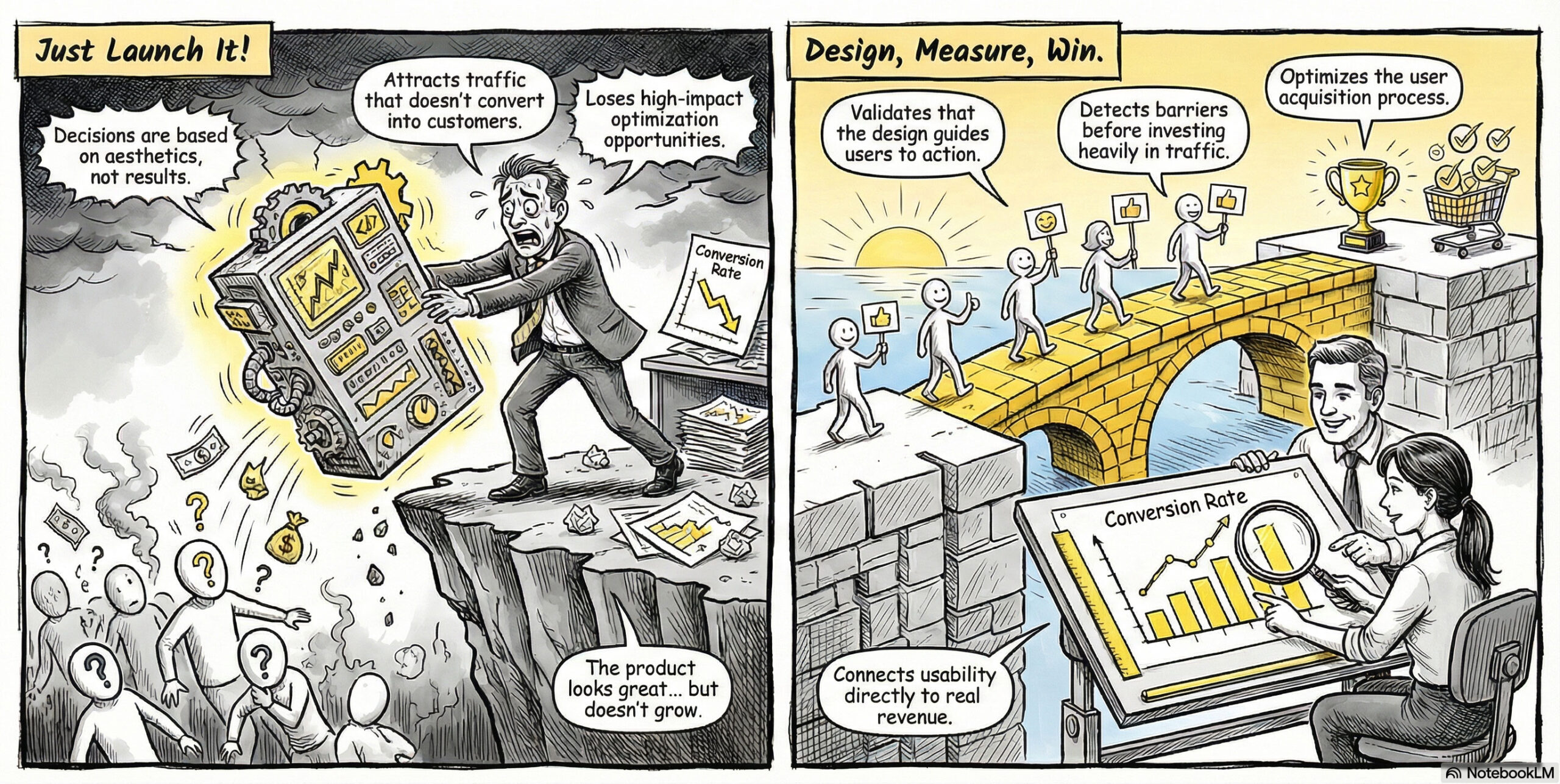
A digital product can have flawless technical architecture and eye-catching visuals, but if it doesn’t convert, it’s a financial failure. Many business leaders operate under the false assumption that functionality is the finish line. In reality, functionality is just the price of entry. Following Steve Krug’s logic: if users have to think too hard to find value, the business has already lost. Ignoring user experience (UX) isn’t an aesthetic oversight; it’s a fiduciary failure that creates critical inefficiencies in customer acquisition and retention.
The Truth About Conversion Rate (CR): The ROI You Can’t Ignore
Conversion Rate (CR) is the north-star metric for any strategist who wants to justify UX investment with hard numbers. It separates vanity traffic from actual revenue. Technically, it’s defined as the percentage of users who complete a desired action out of the total number of visitors:
Conversion Rate = (Number of Conversions / Total Visitors) × 100From the perspective of Jakob Nielsen and the Nielsen Norman Group (NN/g), design isn’t judged by beauty — it’s evaluated by its ability to function as a revenue engine. However, for this metric to be meaningful, leadership must demand measurement consistency. It doesn’t matter whether your team tracks unique users or sessions, as long as the same baseline is used every reporting period to ensure valid comparisons.
Conversion increases are one of the strongest ROI arguments for better UX and more user research. — Jakob Nielsen
For a business with 100,000 monthly visits, a mere 1% lift in conversion isn’t a minor tweak — it’s a capital injection often lost to invisible friction that untrained eyes overlook.
The “Cascade Effect”: Why Early UX Research Pays Compounding Returns
Integrating UX design during early research phases isn’t a luxury — it’s asset optimization strategy. Applying UX rigor from the start creates competitive advantages that directly impact the bottom line:
- Validate that the design naturally guides users toward action: Ensure flows don’t require a user manual.
- Identify barriers before investing in traffic: Catch cognitive roadblocks before marketing dollars are wasted on a broken interface.
- Acquisition optimization: Prepare an environment where every paid click lands in a conversion-ready experience.
- Tie usability to real revenue: Turn “ease of use” from a subjective idea into a measurable financial performance metric.
The Anatomy of Loss: What Happens When User-Centered Design Is Ignored
Decisions driven purely by executive intuition or development speed carry real costs. Skipping professional UX leads to three critical risks:
- Customer acquisition inefficiency: It’s financially irresponsible to spend on marketing just to drive users into a high-friction platform that prevents conversion. That’s wasted traffic.
- Cognitive friction: Every unnecessary step and ambiguous form field increases mental effort, draining user patience and pushing them straight into a competitor’s funnel.
- Opportunity costs: Decisions based on internal opinions instead of behavioral data blind companies to improvements that could double profitability with minimal changes.
The $20,000 Form Field: The Cost of Internal Curiosity
Based on NN/g research patterns, consider a common scenario: a site converting at 10%. The design team identifies that the registration form asks for an extra piece of information that isn’t critical to the transaction, but someone internally finds it “interesting” to collect.
That “internal curiosity” has a price tag. Removing the irrelevant field increases conversion to 11%. If the site gets 100,000 users per year and each conversion is worth $20, that small simplification yields 1,000 additional conversions.
Financial reality: keeping that “interesting” field costs the company $20,000 per year. Professional UX eliminates these corporate whims to prioritize cash flow.
The Myth of Massive Traffic: Quality vs. Quantity
Stakeholders must resist vanity metrics. Jakob Nielsen documented a case where a humorous article about “usability for cats” quadrupled a website’s traffic in one day — yet sales didn’t change. Conversion rate tanked because the traffic wasn’t the target audience.
Strategic Warning: Conversion can be artificially inflated through deep discounts or seasonal demand spikes. But a sustainable, healthy conversion rate is built through design. UX helps filter and guide the right audience, ensuring growth is real — not a statistical mirage.
Usability vs. Conversion: Why 80% Task Success Isn’t Enough
There’s a gap that confuses many leaders: usability studies often show 80% task success, while real-world average conversion rates hover around 3%.
The difference is psychological. In a usability test, users follow a given scenario — we measure whether they’re able to use the product. In the real world, users face price barriers, trust concerns, and commitment thresholds. A site can be technically usable and still fail commercially if it doesn’t reduce perceived risk. Advanced design doesn’t just make a site functional — it makes users want to buy.
A Stakeholder Roadmap: How to Start Driving Revenue Today
To turn functionality into profitability, leaders should act on four immediate pillars:
- Run A/B tests: Stop debating opinions in conference rooms. Test design variants with real users and let data determine the path to higher revenue.
- Simplify navigation: Ruthlessly pursue clarity. If users have to “work” to find a product, your design is working against your sales.
- Optimize load speed: Latency is conversion’s silent killer. A one-second delay is an open invitation to bounce.
- Implement trust signals: Reduce emotional friction with testimonials, security badges, and clear return policies. Trust is the currency of UX.
Conclusion: Design Is the Language of Profitability
A high-level UX/UI designer isn’t a screen decorator — they’re a revenue optimizer. In today’s digital economy, simplicity is a competitive advantage and clarity is money. A product that “works” but doesn’t convert is an underperforming asset leaving revenue on the table.
If your growth metrics are flat despite having a functional system, ask yourself an honest question:
Are you comfortable letting competitors capture the 97% of users abandoning your platform due to friction — or are you ready to make design your strongest financial ally?
Article developed with the support of NotebookLM, based on the KPI “Conversion Rate”.
Want to see it applied?
Subscribe to receive articles about user experience (UX).
5b77ec3b82
You are a wealth of information. I love to see your product working. Metadata and algorithms make life hard for new businesses. It definitely pays off to find someone knowledgeable like you to get started. I sure appreciate you.